
Grapevine Flowering Season: The Ten Days That Decide the Wine Year
Every May, something remarkable happens in vineyards across Spain — and almost nobody sees it. Here's what grapevine flowering season means, why winemakers hold their breath through it, and what it produces in the coastal hills of DO Empordà.
What Is Grapevine Flowering Season?
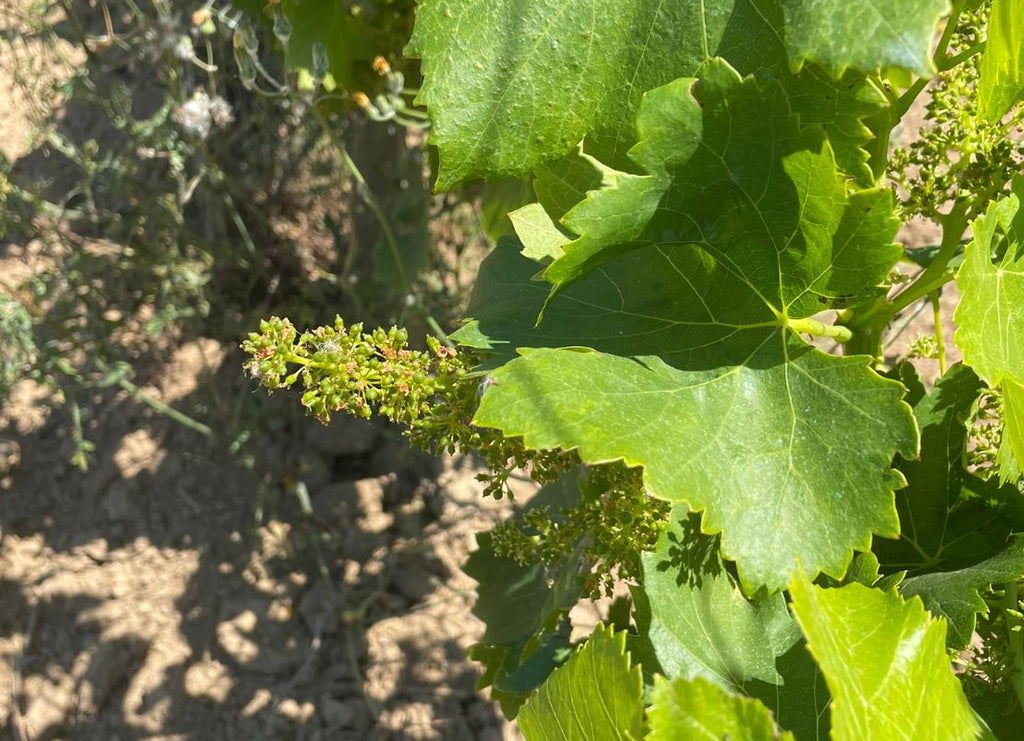
Walk through a vineyard in late May and you might miss it entirely. There are no dramatic blooms, no burst of colour. Just small, pale green clusters — barely the size of a fingernail — emerging from between the vine leaves.
This is flowering season. And for winemakers, it is the most critical and fragile ten days of the entire year.
Grapevine flowering — known technically as anthesis — is the moment when the vine's flower clusters open and pollination begins. Each tiny flower, if successfully pollinated, will become a single grape berry. If flowering goes well, the vintage takes shape. If it doesn't, part of the crop is lost before summer has properly begun.
Why Does Flowering Happen in Late May?
Grapevines are precise in their requirements. Flowering begins when daily average temperatures consistently reach between 15°C and 20°C — the thermal window that reliably arrives across northeastern Spain in late May.
The process follows a predictable sequence. Around 40 to 80 days after budbreak — the emergence of the first green leaves in March — the vine moves into flowering. In DO Empordà, on the Costa Brava, this typically means the last week of May or the first days of June.
From there, winemakers count forward using one of viticulture's most reliable rules of thumb: harvest begins roughly 100 days after flowering sets into fruit. Flowering in late May in Empordà points directly to a September harvest.
Why Flowering Season Is So Fragile
The problem with flowering is that vines are almost entirely at the mercy of the weather during this window — and weather doesn't negotiate.
For successful fruit set, the vine needs:
-
Stable temperatures between 15°C and 25°C. Too cold and the flowers fail to open properly. Too hot and pollen viability drops.
-
Dry conditions. Rain during flowering washes pollen away before pollination can complete — a phenomenon called coulure, which can reduce yields dramatically.
- Minimal wind. In regions like Empordà, where the powerful Tramuntana wind defines the landscape, flowering season requires a temporary pause in the wind's characteristic force.
When conditions align, fruit set is strong and the vintage begins with confidence. When they don't, the winemaker faces a reduced crop months before harvest — with no possibility of correction.
This is why wine people speak about vintages with a reverence that can seem excessive to outsiders. The difference between a great vintage and a difficult one is often decided not in the cellar, not at harvest, but in these ten days in late May when the vine is flowering and the weather is doing whatever it chooses.
Flowering Season in DO Empordà
We were in the vineyards of DO Empordà this week — and these photographs show exactly what flowering season looks like in one of Spain's most distinctive and underappreciated wine regions.
Empordà sits at the northeastern tip of Catalonia, where the Pyrenees descend towards the Mediterranean and the Tramuntana wind — one of the most powerful and characterful winds in the Iberian Peninsula — shapes everything it touches. The soils are ancient: silex, clay, sand and limestone, worked by families who have been here for generations.
It is not a region that makes wine for show. The landscape is too honest for that, and the winemakers who have stayed here have chosen depth over fashion. The wines produced in these hills carry the memory of the wind, the coast and the specific week of each vintage — including this one, beginning now, in flowering season 2026.
The Empordà Wines in Our Cellar
These are the bottles we carry from DO Empordà — each one the product of families who have farmed these vines through flowering season after flowering season, year after year.
Camí de Cormes Negre 2018 — €35
Four generations of the Cormes family have tended twelve hectares in Mollet de Peralada — organically farmed, hand harvested, aged in French oak. The wine carries vivid garnet with violet reflections, red fruit, floral lift and lively acidity with well-marked tannins and a persistent finish. This is what Empordà tastes like when a family refuses to take shortcuts.
Shop Camí de Cormes Negre 2018 →
Camí de Cormes Blanc 2019 — €23
The same family, a completely different expression. 100% Grenache Gris — known locally as Garnacha Roja — from ancient vines on silex, clay and sandy soils at 50 metres altitude. Hand harvested in September, skin macerated, aged on lees for three months split between French oak and stainless steel. Only 3,200 bottles produced. Quince, apricot, lactic notes and a structured, persistent dry finish.
Shop Camí de Cormes Blanc 2019 →
Proposit Negre 2018 — €19
David Saavedra's own project at Celler Viníric on the Costa Brava hills, where the Gavarres mountains meet the Mediterranean. A blend of 50% Syrah, 25% Cabernet Sauvignon and 25% Merlot — each variety aged separately, exactly as long as it deserves. The Syrah: 12 months in French oak. The Cabernet Sauvignon: 18 months. The Merlot: unwooded, kept fresh, contributing the fruit energy that balances the blend. Velvety, balanced and made to drink slowly.
Usted Organic 2015 — €167
Terra Remota — remote land — is exactly what its name promises. Founded in 1999 by the Bournazeau Florensa family on 40 hectares in Alt Empordà, this is a limited edition organic blend of Garnacha and Syrah vinified parcel by parcel, each batch processed separately in small tanks and wooden vats, aged in wood and non-replicable by design. The 2015 now carries a full decade of bottle development: cherry in brandy, truffle, cocoa, lead minerality, silky melted tannins and a long salivating finish. Open when the occasion demands something that cannot be replaced.
A Final Thought on Flowering Season
The next time you open a bottle, consider what was at stake in the vineyard ten days in late May — months before that wine was made, years before you poured it. The balance in the glass, the depth of fruit, the length of the finish: all of it traces back to a week when tiny flowers opened on ancient vines, and the weather decided to cooperate.
That is what makes wine unlike anything else.
Explore all Dis&Dis Empordà wines →
Dis&Dis — Dare to Discover. International wine delivery from the world's most interesting vineyards.
Related post
16
Sep