
What Is Madiran? France's Most Powerful Red Wine, Explained
There is a corner of southwest France, tucked against the foothills of the Pyrenees, where a grape grows that most winemakers in the rest of the world have never seriously considered planting. It produces wines with tannin levels so high that, historically, local winemakers routinely blended it with softer varieties just to make it approachable. Restaurants along the pilgrimage route to Santiago de Compostela poured it for centuries because it was local and it was serious, and the pilgrims who drank it were about to walk several hundred miles and needed something with genuine substance behind it.
The grape is Tannat. The appellation is Madiran. And despite being one of the most distinctive, age-worthy red wines France produces, almost nobody outside the southwest has heard of it.
Where Madiran Is
Madiran sits in the Hautes-Pyrénées and Gers departments of southwest France — Gascony, technically, in the rolling foothills that rise toward the Spanish border. It is not a region that features heavily in international wine conversations. The appellations that dominate those conversations — Bordeaux, Burgundy, the Rhône, Champagne — all lie north or east. Madiran belongs to a different France entirely: the France of confit de canard, foie gras, Armagnac, and the kind of slow-cooked, richly flavoured cuisine that was built around the wines produced alongside it.
The appellation was granted AOC status in 1948 and covers around 1,300 hectares of vineyard, which makes it small by any standard — a fraction of Bordeaux's footprint, producing wines that reach far fewer international shelves as a result. That obscurity is not a reflection of quality. It is simply a function of geography, scale, and the relative difficulty of selling a wine whose primary grape variety requires some explanation.
The Grape That Defines Everything
Tannat is Madiran's reason for existing. The variety is believed to have originated in the Basque Country before spreading through southwest France, and it has adapted so completely to the specific conditions of the Madiran appellation that it accounts for at least 60% of every wine made here by law — with many estates, including ours, using 95% or more.
The name comes from the French word for tannin, which tells you everything you need to know about the variety's character. Tannat has among the highest tannin levels of any red grape grown in France — thick-skinned, deeply pigmented, producing wines of extraordinary structural power that, in lesser hands or lesser vintages, can feel more like something to chew than to drink. In the right hands, in a good vintage, those tannins are the architecture around which everything else is organised: dark fruit, a mineral edge, and the kind of persistence on the palate that makes you think about the glass long after it's empty.
The variety's unusual tannin profile has also attracted the attention of cardiologists, for reasons that go beyond the general association between red wine and cardiovascular health. Tannat contains exceptionally high levels of procyanidins — a class of polyphenol antioxidants — which has made Madiran the subject of genuine scientific interest in France and abroad, though this post is about wine rather than medicine.
The Santiago de Compostela Connection
The great pilgrimage route from central France to the shrine of Saint James in northwest Spain passes through Madiran. It has done so for over a thousand years, and for most of that time, the pilgrims who walked it drank the local wine. Tannat's high tannin and alcohol gave it both the structure to hold up in basic storage conditions and the caloric density to fuel people who were, in the most literal sense, walking across a country.
That history explains something about Madiran's character. This is not a wine developed for a sophisticated urban market looking for elegance and refinement above all else. It is a wine that grew up alongside hard physical labor and hearty Gascon food, and it carries that heritage in every glass — substantial, serious, built to last, and completely indifferent to fashion.
How It's Made
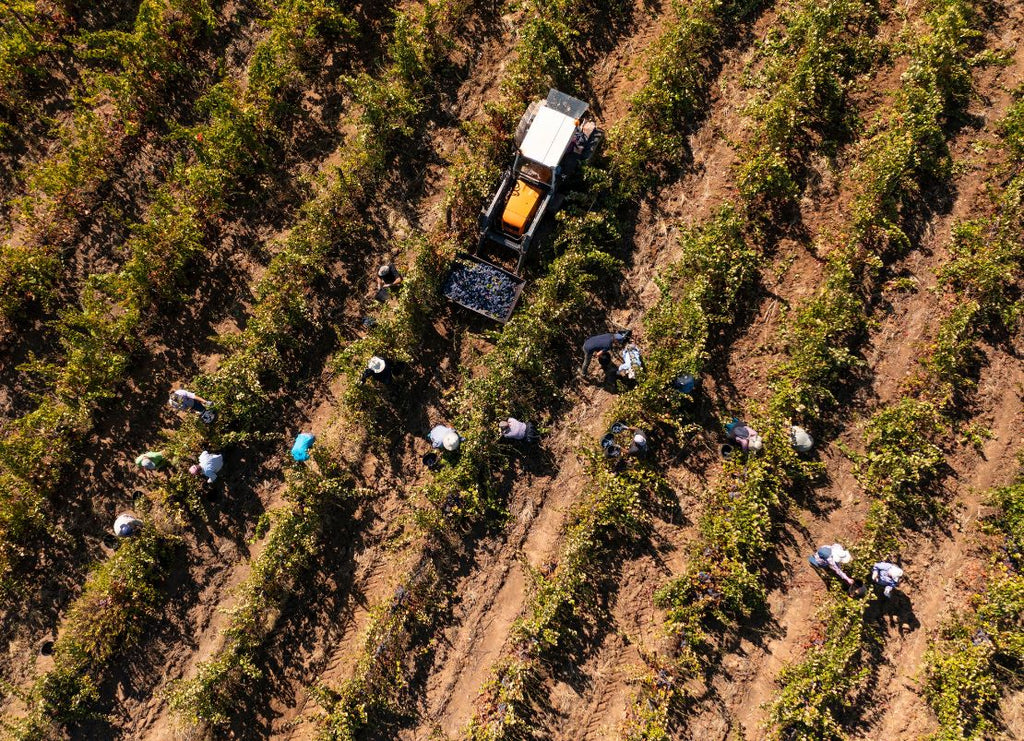
Première Madiran 2019 is made from 95% Tannat and 5% Cabernet Sauvignon — the small proportion of Cabernet doing the work of softening the Tannat's naturally aggressive tannin structure without compromising the variety's essential character. The grapes are hand-harvested from the Pyrenean foothills, given 15 days of maceration to extract the colour, structure, and fruit intensity that defines the appellation, then aged in vat where the tannins soften and the fruit develops the freshness that makes this wine more approachable than Tannat's reputation might suggest.
The result pours deep ruby, with raspberry and dark fruit on the nose and the kind of tannin structure that opens gradually in the glass rather than hitting immediately and sitting there. This is Tannat made with restraint — not by removing the variety's power, but by respecting it rather than forcing it.
What Bernard Magrez Brings to an Obscure Appellation
Bernard Magrez owns four Grand Cru Classé estates in Bordeaux and more than forty properties across nine countries. His decision to produce a Madiran is the same logic that governs everything else in his range: that quality winemaking applied to an underappreciated appellation produces wines worth discovering, and that the standard he sets at his Grand Cru estates should apply regardless of what the label says.
Première Madiran carries his name as a guarantee. Not as a marketing device — as a statement about the commitment behind what's in the bottle, backed by four decades of building one of the most credible wine portfolios in France.
What to Eat With It
Madiran was built for Gascon food, which means it was built for the richest, most flavourful cooking in France. Confit de canard, cassoulet, foie gras, magret de canard — anything where duck fat is a primary ingredient rather than an afterthought. The tannins cut through the fat in a way that lighter reds cannot, and the wine's structure demands food with equivalent weight.
Beyond Gascony: aged hard cheeses, slow-braised lamb or beef, game, and any dish where the cooking time is measured in hours rather than minutes. Madiran is not a wine for delicate food. It is a wine for serious food, and it makes that food better.
Serve at 16-18°C, and if time allows, open the bottle an hour before serving — the tannins open considerably with air, and the fruit that emerges once they do is genuinely worth waiting for.
Madiran and Cahors: Southwest France's Two Great Reds
Madiran is not the only distinctive red appellation in southwest France worth knowing. Cahors, made from Malbec (locally called Côt or Auxerrois), produces wines of similar structural authority from vineyards further east along the Lot River. The two appellations are often mentioned together as the twin pillars of southwest French red wine — and we carry both, making a comparison genuinely possible rather than theoretical.
If Madiran is power and longevity, Cahors is the somewhat more accessible face of the same southwest tradition — different grape, different river, the same unwillingness to compromise with international fashion.
Frequently Asked Questions
What is Madiran wine? An AOC red wine appellation in the Pyrenean foothills of southwest France, made predominantly from Tannat — one of the most structurally powerful red grape varieties in France.
What does Tannat taste like? Dark fruit — blackberry, plum, raspberry — with high tannins, deep colour, and a mineral, structured character that softens significantly with age and with decanting.
Is Madiran wine similar to Bordeaux? Both are serious, age-worthy French reds, but they taste quite different. Madiran is darker, more tannic, and more rustic in character — less polished but more powerful than most Bordeaux at the same price.
What food pairs best with Madiran? Rich Gascon cuisine — confit de canard, cassoulet, foie gras — alongside aged hard cheeses, slow-cooked lamb or beef, and game. The tannins are built for fat and protein.
Why is Tannat good for you? Tannat contains exceptionally high levels of procyanidins — antioxidant polyphenols — which have attracted scientific interest for potential cardiovascular benefits, though wine is not a health product and this should not be the reason you open a bottle.
Discover Première Madiran 2019 → [https://disndis.com/products/premiere-madiran-2019]
You might also like: [Première Cahors 2017] · [Première Bergerac 2018]
Related post
24
Sep