
Tuscan Wine: The Honest Guide to Chianti, Vino Nobile and Everything In Between
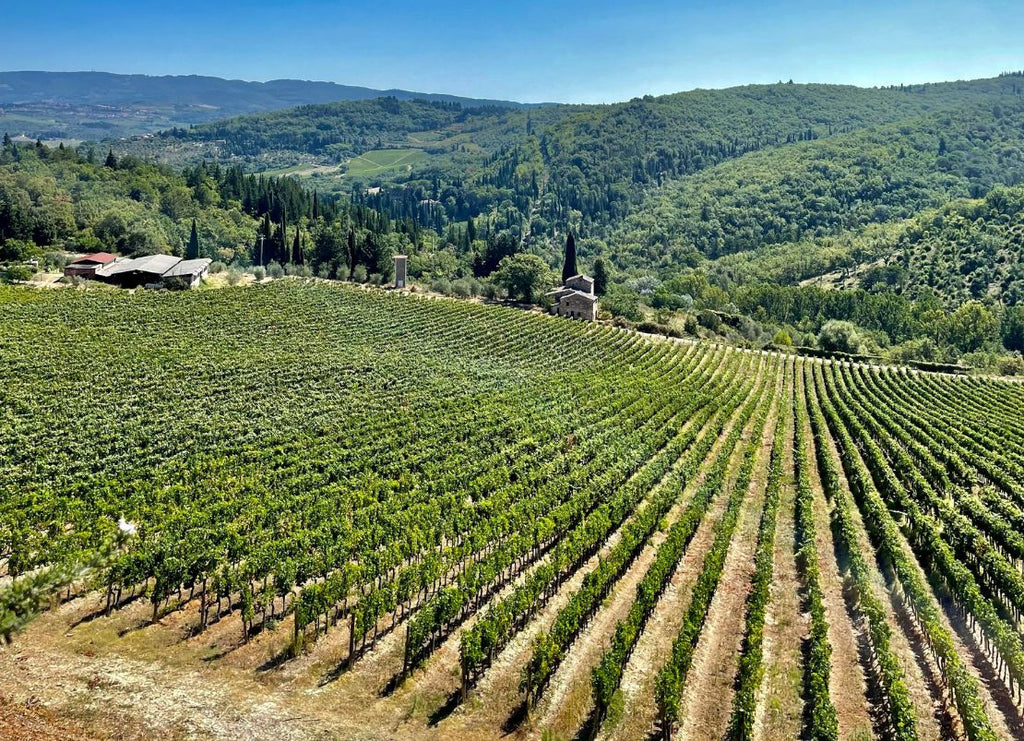
Tuscany is the reason most people get serious about wine. It's not the first Italian wine region they try — that's usually Pinot Grigio, or a supermarket Chianti — but it's often the one that makes the category feel genuinely worth understanding. The hills between Florence and Siena, the Renaissance towns on their hilltops, the Sangiovese vines that have been growing in this specific landscape for centuries: it's a region whose wines carry the weight of the place they come from in a way that's immediately legible even to someone who hasn't tasted a lot of Italian wine.
The problem is that Tuscany is also confusing. Chianti is not one wine — it's a classification with multiple subzones, a contentious recent history, and a quality range that runs from supermarket commodity to some of Italy's finest bottles. Vino Nobile di Montepulciano sounds like it should be from Montepulciano d'Abruzzo and isn't. Brunello di Montalcino is a different wine from Brunello. The Super Tuscans exist outside the classification system entirely and are sometimes the most serious wines in the region.
Here's how it actually works.
Sangiovese: The Thread That Connects Everything
One grape runs through virtually every red wine in Tuscany: Sangiovese. It goes by different names in different parts of the region — Prugnolo Gentile in Montepulciano, Morellino in Maremma, Brunello in Montalcino — but it's the same variety, adapted over centuries to the specific conditions of different hillsides. This is the most important thing to understand about Tuscan wine: the differences between a Chianti Classico, a Vino Nobile, and a Brunello are not primarily differences of grape variety. They are differences of place, altitude, soil, winemaking tradition, and the specific clone of Sangiovese that each zone has selected and refined over generations.
Sangiovese is not an easy grape. It has naturally high acidity, significant tannin, and a tendency toward rustic, difficult character when grown badly or harvested at the wrong moment. When grown well — on the right limestone and clay soils, at altitude, by someone who understands what they're working with — it produces wines of extraordinary complexity, longevity, and site-specificity. It is, in many ways, Italy's answer to Pinot Noir: frustrating, unforgiving, and incomparable when it works.
Chianti Classico: The Original and the Best Version
Chianti as a category covers a large swath of central Tuscany, with subzones including Chianti Rufina, Chianti Colli Fiorentini, and others. The wine that most serious buyers and most wine writers are actually talking about when they say Chianti is Chianti Classico — the original and most historically significant subzone, covering the hills between Florence and Siena where Chianti's identity was formed.
The black rooster — Gallo Nero — on the neck label is the sign you're looking at a genuine Chianti Classico. The consortium that controls the appellation created this symbol in the 1920s (and it dates even further back, to a 13th-century Florentine military company), and it remains the most reliable shorthand for authenticity in the entire Chianti category.
In 2014, Chianti Classico introduced a new tier — Gran Selezione — for single-vineyard or best-selection wines aged for at least 30 months. Below it, Riserva requires 24 months ageing; standard Chianti Classico requires 12. The tier matters enormously for buying decisions: a basic Chianti Classico is an everyday wine of genuine character; a Gran Selezione from a serious producer is a wine that competes with the region's best.
Our Carpineto Chianti Classico 2019 comes from one of the zone's most committed estates — founded in 1967 in the village of Dudda, just outside Greve in Chianti, by two families who remain in full ownership and control today. Five estates, 500 hectares, carbon-neutral production, and a chief winemaker — Caterina Sacchet — who represents the next generation of a family that has spent five decades proving Chianti Classico is worth taking seriously. The wine is 80%+ Sangiovese with Canaiolo, aged in oak, with the violet, cherry, and earthy complexity the zone produces in its best expressions. It is, in other words, exactly what Chianti Classico should taste like and frequently doesn't.
Vino Nobile di Montepulciano: The Misunderstood DOCG
Vino Nobile di Montepulciano is not Montepulciano d'Abruzzo. This confusion causes more wasted money in Italian wine than almost any other labelling quirk, so it bears stating clearly: Montepulciano d'Abruzzo is a wine from the Abruzzo region, made from the Montepulciano grape. Vino Nobile di Montepulciano is a wine from the hilltop town of Montepulciano in Tuscany, made from Sangiovese (locally called Prugnolo Gentile) with a small percentage of Canaiolo. Different grape, different region, different wine entirely.
The "Noble" in the name is historical. In earlier centuries, the wine was considered so fine that it was reserved for noble families — a claim that could be marketing mythology or genuine heritage depending on who you ask, but one that at least signals the aspiration the appellation has always carried.
Vino Nobile received DOCG status in 1980 — among the very first Italian wines to do so, alongside Barolo, Barbaresco, Brunello di Montalcino, and Chianti Classico. That original group is still the reference for Italian quality, and Vino Nobile is too often the overlooked member of it.
Our Vino Nobile di Montepulciano Riserva 2017 from Carpineto is the Riserva tier: aged for two full years in large Slavonian oval oak casks, with a portion in French oak, then additional time in bottle before release. Bright ruby with garnet tones. On the nose, elegant — violet, wood, the mineral quality that altitude and limestone bring to Sangiovese in this specific corner of Tuscany. On the palate: dry, harmonious, velvety, with a long finish and the kind of structure that opens over hours in a decanter. Decant for one hour before serving at 18°C. Pair with aged cheese, red meat, or game.
Barolo: The Other Italy
Tuscany gets most of the attention. Piedmont produces Italy's other undeniable claim to wine greatness: Barolo, from Nebbiolo grapes in the fog-covered hills south of Turin.
Nebbiolo is to Piedmont what Sangiovese is to Tuscany — a demanding, site-specific variety that produces wines of extraordinary complexity and longevity when everything goes right. Barolo is called the King of Wines and the Wine of Kings, which is the sort of phrase that gets applied to wines by committees rather than drinkers, but in this case carries real meaning: the greatest Barolos are genuinely kingly in their authority, depth, and capacity for ageing.
Our Barolo Paesi Tuoi 2017 comes from Vite Colte — a winery built below the Barolo crus that makes some of the most accessible and honest expressions of Nebbiolo available at a non-collector price. 100% Nebbiolo, DOCG, the characteristic tar and roses aromatics that Nebbiolo produces in Barolo's limestone-clay soils, with the structured tannins that demand food and reward patience. This is the wine to open when the occasion justifies something serious and Italian that isn't Chianti.
The Super Tuscans: When the Rules Don't Apply
In the 1970s, a group of Tuscan producers made a decision that seemed commercially suicidal: they began blending Sangiovese with Cabernet Sauvignon, Merlot, and other international varieties, and they did it in ways that fell outside Tuscany's existing DOC regulations. Since the regulations didn't cover what they were making, these wines were classified as Vino da Tavola — table wine, the lowest tier in Italian classification — despite being, in several cases, the finest wines in the region.
The market disagreed with the classification. Sassicaia, Tignanello, Ornellaia — what became known as the Super Tuscans — commanded prices that embarrassed the DOCG tier above them and eventually forced a regulatory response: the creation of the IGT Toscana category that now covers wines made outside traditional DOC/DOCG rules but within a defined geographic area.
Our Imani Toscana by Bernard Magrez is precisely this: an IGT Toscana built on Sangiovese (70%), Cabernet Sauvignon (25%), and Petit Verdot (5%), with 8 days of maceration and 6 months in barrel. The Super Tuscan philosophy — using international varieties to add structure and aromatic complexity to Sangiovese's fruit — applied by a producer whose standards are set at four Grand Cru Classé Bordeaux estates and carried through to everything else he makes. Ruby red, ripe cherry and red fruit on the nose, round and balanced on the palate with a smooth finish.
The Rest of Italy's Range in Our Collection
Valpolicella Classico Superiore, Villa Girardi — From a Venetian villa dating to the 1700s in the heart of Valpolicella, north of Verona. The Classico Superiore designation requires an additional year of ageing beyond standard Valpolicella, producing a wine of more concentration and complexity than the region's entry-level bottlings. Molinara, Rondinella, and Corvina — the classic Valpolicella blend — with the cherry and bitter almond character that makes this one of Italy's most food-versatile reds.
Organic Barbera d'Asti, Vite Colte — From the same Piedmontese winery as our Barolo, Barbera d'Asti represents Piedmont's more immediately approachable face: lower tannin, higher acidity, the kind of wine that works on a weeknight alongside pasta or risotto rather than demanding the occasion of a Barolo. Certified organic.
Nero d'Avola, Luna Sicana — Sicily produces something no other Italian region can: wines from the Nero d'Avola grape, dark, warm, and intensely Mediterranean, shaped by volcanic soils and the kind of sunshine that doesn't reach Piedmont or Tuscany. A Zita Cu Zitu — in Sicilian dialect, the union of two souls — is the estate's signature expression of a variety that is becoming increasingly recognised internationally as one of Italy's genuine originals.
How to Buy Italian Wine Without Getting Lost
The single most useful rule is also the simplest: pay attention to the producer, not just the appellation. A Chianti Classico from Carpineto is a fundamentally different proposition from a supermarket Chianti Classico that happens to carry the same classification. The appellation sets the floor; the producer sets the ceiling.
The second rule: the tier matters. Riserva costs more than standard, Gran Selezione costs more than Riserva, and the price difference is usually justified by meaningfully longer ageing and more careful fruit selection. Buy the tier that matches the occasion.
The third rule: Tuscany is not all of Italy. Barolo, Valpolicella, Barbera d'Asti, Nero d'Avola — these are wines from completely different regions with completely different characters. Exploring Italy through its appellations rather than through its most famous names is how you discover what makes it genuinely extraordinary.
Frequently Asked Questions
What is the difference between Chianti and Chianti Classico? Chianti is a broad category covering multiple Tuscan subzones. Chianti Classico is the original and most prestigious subzone, between Florence and Siena, identifiable by the Gallo Nero (black rooster) symbol on the label.
Is Vino Nobile di Montepulciano the same as Montepulciano d'Abruzzo? No — they share a name but are completely different wines from different regions, made from different grapes. Vino Nobile is made from Sangiovese in Tuscany; Montepulciano d'Abruzzo is made from the Montepulciano grape in Abruzzo.
What makes a wine a Super Tuscan? Super Tuscans are Tuscan wines made outside traditional DOC/DOCG regulations, typically blending Sangiovese with international varieties like Cabernet Sauvignon or Merlot. They are classified as IGT Toscana.
What food pairs best with Tuscan wine? Chianti Classico pairs naturally with pasta in tomato sauce, grilled meats, and aged Pecorino. Vino Nobile works with game, red meat, and aged cheese. Barolo demands rich, long-cooked dishes — braised beef, truffle, aged Parmigiano.
Is Barolo a Tuscan wine? No — Barolo is from Piedmont in northwest Italy, made from Nebbiolo. It is often discussed alongside Tuscany's great wines because together they represent Italy's finest red wine traditions.
Discover our full Italian wine collection →
You might also like: [Carpineto Chianti Classico 2019] · [Vino Nobile di Montepulciano Riserva 2017] · [Barolo Paesi Tuoi 2017] · [Imani Toscana Bernard Magrez]
Related post
24
Sep